The Daily Otter ([syndicated profile] daily_otter_feed) wrote2026-05-06 10:38 am

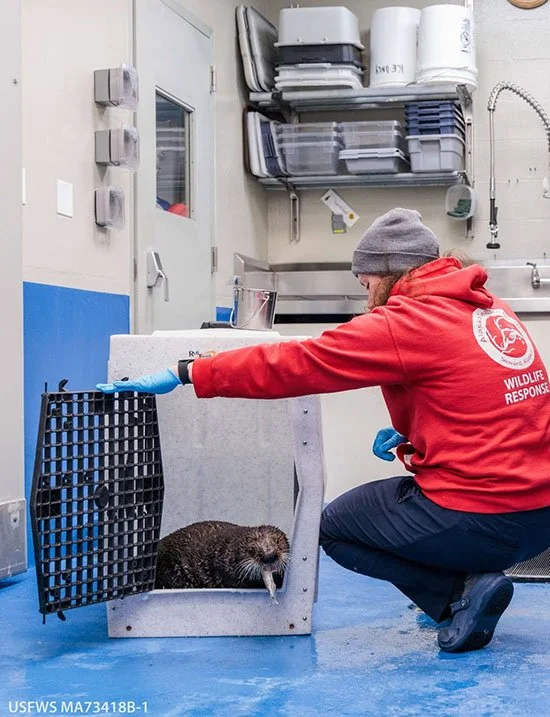
Sea Otter Pup Gets Ready for the Big Move

Posted by Daily Otter

Via Alaska SeaLife Center, which writes:

The rehabilitated otter pups are taking huge strides towards their next chapter in life with kennel training. Our staff have been introducing the otters to kennels and transport units, slowly increasing time so the otters will be as comfortable as possible when they make their big move.

And because we know you’ll ask, we’re not ready to announce where they are heading to quite yet. We’ll share updates as soon as we are able!

sovay: (Otachi: Pacific Rim)
sovay ([personal profile] sovay) wrote2026-05-05 09:48 pm

To the green field by the sea

Counting by months, [personal profile] rushthatspeaks and I have been together for fifteen and a half years and married for five and a half and missed any formal celebration of our last anniversary because I was on my way to a hospitalization and so when we found ourselves this afternoon at Castle Island where an absurdly stiff breeze was scooting parasailers like hi-vis velella all over Pleasure Bay, the most natural thing when we tired of walking a wind tunnel around the faience-glinting waves was to pursue a meal on the brick-backed patio of our traditional anniversary restaurant, South Boston's ten-year-old Venetian-style bacaro SRV. We found street parking right around the corner. We ordered a smattering of cicchetti—the never-bettered polpette in their velvet of red sauce, the squid-black crostini topped with salt tufts of baccalà, a translucent dab of quince atop a sweetly plush mouthful of ricotta and salumi, an astonishing smear of uni and oyster butter sharpened with mignonette, plus a kitchen gift of lightly crisped eggplant—and a lambent scallop crudo dressed like the jeweled sea with tiny cubes of astringent kiwi and creamy pistachio and torn fresh mint, served on a shell I would have kept if it had come from a beach and not a restaurant I wanted to let me back through its doors ever again. Even the foccacia was bouncy, salt-skinned, assertive enough to eat even without wiping out the bright tomato sauce left over from the eggplant. My amaro mocktail was as darkly herbal as if it could have gotten me high and Rush-That-Speaks' Salt of the Earth was a tongue-spinning concoction of mezcal, fennel, and absinthe that should not have been able to taste so much like green brine. We wrote them an appreciative note and promised to return before autumn, declining their non-negligible roster of desserts in favor of checking out Uncommon Ice Cream up the street, which had not existed the last time we ate at SRV. Rush got the strawberry which really meant its cinnamon toast crunch swirl and I had the savorily flecked rosemary honeycomb. It had been actual ages since I just walked into a restaurant for an affordably luxurious meal with someone I loved, as in the pre-glacial world I could inhabit more or less safely. The two-hour free space on Mass. Ave. was just a present from the parking gods.

Snips and Snails and Puppy Dog Tales ([syndicated profile] thistlelj_feed) wrote2026-05-06 01:44 am

Book #64 of 2026: The Hidden, Book #65: Starstuff, 2 DNF


The Hidden (Animorphs #39) by K.A. Applegate.

Quick synopsis: The Yeerks somehow find and repair a Helmacron ship. As Helmacrons are about a sixteenth of an inch tall, finding one of their crashed ships is quite a feat... At the same time, in contrast to all the lore in the series so far, a buffalo just happens to gain the ability to morph and then just happens to acquire Cassie. And then an ant does too...

Brief opinion: I really, really, really did not like this one. The logic made no sense (the buffalo and ant gaining ability to morph), and in the entire series thus far you need to touch an animal and concentrate on the DNA to acquire it. Plus, from the height a bird flies, Cassie unmorphs and remorphs into a whale to hit a helicopter... Morphing takes minutes to do.

How does this opinion compare to my original review in 2019: In 2019 I had said "The most I can say about this one is that it wasn't the worst book of the series. I guess it wasn't even bad?". This is one of those rare times when I completely disagree with past-me. I hated this book. Really really hated it.

Plot: For completely unbelievable reasons, the Yeerks end up with a damaged Helmacron ship. And somehow they repair the tiny thing. The Helmacron ship has some kind of tech to detect "morphing energy" (I can't remember if that was a thing in the Helmacron book or if it was made up for this one). So now the Yeerks can find the Animorphs (and the cube that gives the morphing power).

So the Animorphs race around the world across their state through their city around the woods near their homes, trying to avoid the Yeerks. And, while they "can't morph" while doing this, they endlessly morph. Like more than in any other book so far.

Just by complete chance a cape buffalo is being transported in a truck. Cassie, with the morphing cube, hides in that truck. She sets the cube down on the floor, and when a Yeerk opens the truck's loading door and the buffalo rushes out, it just happens to touch the cube. And then it brushes by Cassie and just happens to acquire her.

Later in the story, for no reason at all, Cassie sets the cube down on the ground. An ant just happens to crawl across it and gains the ability to morph. Then that same ant just happens to crawl up Cassie's shoe, across her sock, and onto her leg. Thus, in contrast to all the lore in the 40+ books so far, acquires her.

The kids argue and angst about killing the buffalo (it has human DNA now, so is it okay to kill it? is it a person now?). Cassie doesn't give even a single thought to killing the ant with human DNA though.

In the end, the plan to destroy the Helmacron ship is for Cassie in bird morph to fly above the helicopter carrying it, morph into a whale, and so fall on it, causing it to crash. This is the plan, even with all the kids knowing it takes multiple minutes to morph...

Editing: More errors than previous books, but no idea how many are scanning issues vs actual editing issues.

What I Liked/What I Didn’t Like: There wasn't a single thing I liked about this book. The idea of a buffalo being able to take human shape (though still having the mind of a buffalo) could have been really interesting, but even that wasn't handled well.

Rating: 1-Hated / 2-Disliked / 3-Okay / 4-Liked / 5-Loved: ⭐️ - Hated

-----

Starstuff: Ten Science Fiction Stories to Celebrate New Possibilities by various.

Quick synopsis: From the official summary: "A collection of hard science fiction for curious middle-graders and an antidote to despair in the face of dystopian uncertainty."

Brief opinion: As with all anthologies, some stories worked for me, most didn't.

Plot: The ten stories:

To-do List for the Apocalypse by Jenn Reese. An interesting story to start with, because it was pretty heavy and sad until the very end. A giant asteroid is headed straight for Earth. At the same time, River's parents are getting divorced, so River and her mother are driving from New Jersey to their new home in California, leaving all her friends and her whole life behind. At the very end of the story there was a twist as to what the asteroid really is. ⭐️⭐️⭐️⭐️ ½ - Liked a lot

Calm Down People! It's Just Space Bees by Carlos Hernandez. A young girl becomes the first minor to go into space. On one hand, I really liked this story. Orquidea Bandana is a really smart kid and it shows, yet her interactions with the adults were perfectly realistic and believable. On the other, even though this was set far in the future, she uses current (2025) internet slang. I guess that would make the story more accessible to young readers, but it kept marring the believability for me. ⭐️⭐️⭐️⭐️⭐️- Loved, even with the slang issue

The Whistleblowers by Kekla Magoon. I DNFed this one. A drug company is lying to the public for profit. The message seemed heavy handed, the two main characters weren't distinctive enough to keep straight who was who, and the story being told in a non-linear way didn't help at all. ⭐️⭐️ - Disliked

Aesop's Elevator by William Alexander. I thought I was going to love this one, but it ended up being heavy handed. A barely disguised Elon Musk races his environment-killing, ego-fueled rockets against an environmentally friendly space elevator. The footnotes with science facts were so distracting as well. ⭐️ ½ - Really, really disliked. No one needs more Musk in their life.

Zabrina Meets the Retro Club by Maddi Gonzalez. This story is a graphic novel, and it was just too small on my Kindle screen to read. Skipped it, no star rating.

The Most Epic Nap in the Universe by A. R. Capetta. Even though this is a book for MG readers, this is the first story that felt like it was written for child readers. It was about a girl trying to keep her best friend, when the reality of space travel made it seem impossible. Plus I hate second-person POV. ⭐️⭐️ - Disliked

A Proposal to the Animal Congress by Eliot Schrefer. Based on the title alone, I thought I would love this one, but it was nothing like what I expected. Set in the future, AI lawyers(?) represent animal species. The whole story was two AIs texting to each other. DNF. ⭐️ ½ - Disliked a lot

Of What We Never Were by David Robertson. This one was another weird one to be included in an anthology of positive stories. A girl has a best friend, Adam, who is AI (or seems to be). She has no connection with the real people around her because she spends time only with Adam and talks only with him. Then the company who created Adam turns him off... Only the last paragraph was positive (and even then only somewhat). Another heavy-handed story that I didn't enjoy much. ⭐️⭐️ - Disliked

Red, Right, Returning by Fran Wilde. In this one a young girl "borrows" some software her father is working on, and somehow it pulls in copies of her from other worlds. I usually like multiverse stories, but this one just did not work for me at all. DNFed it towards the end. ⭐️⭐️ - Disliked

The Traveler by Wade Roush. What is it with these authors and Musk? Can no one envision a future of humans in space without him? *huff* Anyway, this lackluster story was about a girl who sent a time capsule into space. At least it was more positive than a number of other stories in this book. Didn't really work for me though. ⭐️⭐️ ½ - Meh

Editing: Very good.

What I Liked/What I Didn’t Like: I wish anthologies worked better for me. There are always too many stories I don't like compared to ones I do. I had planned not to get any new ones, so I'm not sure why I picked this one up. Anyway. This one worked for me no better than they ever do. I felt like I read a whole book that I didn't enjoy.

Rating: 1-Hated / 2-Disliked / 3-Okay / 4-Liked / 5-Loved: Average of the nine stories (skipping the graphic novel one): ⭐️⭐️ ½ - Disliked. Feels about right, though I'd drop that half star.

-----

DNF #24: The Ravenous Sky by Kurt Kirchmeier. After loving the first book so much, it pains me to DNF this one, but I just wasn't enjoying it. I didn't believe that the teenage characters so quickly figured out the (new) problem with the world. And, unlike the first book, the voices of the two characters weren't distinctive at all -- I kept losing track of which character's chapter I was reading.

DNF #25: Orconomics by J. Zachary Pike. Clearly my sense of humor doesn't match a lot of other people's. Some reviewers called this the funniest book ever, the funniest piece of media ever. It didn't even mildly amuse me. If anything, the jokes tended to annoy me.

I like my fantasy books to be fantasy books, not a "satire that attacks the tenets of capitalism". DNFed about 20% in, but I really should have dropped it right away. Just not the book for me.
cupcake_goth: (Leeches)
cupcake_goth ([personal profile] cupcake_goth) wrote2026-05-05 01:32 pm

In which I am an unobservant idiot

We went out to dinner last night at an upscale steakhouse that has an Argentinian theme. My steak was delicious, but I misread the menu and thought the steak came with fancy mashed potatoes. No, that was an option, but the standard is polenta. And because I haven’t had polenta in YEARS, I didn’t realize what it was until I’d eaten about a third of it.

I immediately took an interrupt med, which helped keep the migraine down to a mid-range level. I took all the preventative things when I went to bed; when I woke up at 5-ish to go to the bathroom I felt okay. Then the alarm went off and everything was awful. So I have tapped out from work and filed my intermittent leave claim.

God, the polenta was delicious. :: weeps ::


oursin: Grumpy looking hedgehog (grumpy hedgehog)
oursin ([personal profile] oursin) wrote2026-05-05 08:19 pm

State of the blahs

Have not been sleeping terribly well lately, thus the blahs.

Not sure why this is, because it is not lower back kicking up etc (yay physio) but more that annoying thing of Morpheus seeming very skittish.

Possibly the whole life-admin stuff that going on at the moment? (2nd appt with our Person of Law next week, also appt to Register Our Intentions.)

Perchance the Even Tenor of Our Ways is just a leeetle disturbed.

Still, am doing my best to pull together Something Entertaining and Instructive on Condoms and related matters, which is largely remixing stuff which I do already have, but not entirely.

Am a bit annoyed that I was informed that I could anticipate proofs of a review today but so far no can haz, would have liked to get that out of the way.

ysabetwordsmith: Cartoon of me in Wordsmith persona (Default)
ysabetwordsmith ([personal profile] ysabetwordsmith) wrote in [community profile] birdfeeding2026-05-05 01:05 pm

Birdfeeding

Today is cloudy and cool. It stormed last night.

I fed the birds. I've seen a few sparrows and house finches.

I put out water for the birds.

EDIT 5/5/26 -- It's raining again.

I've seen a male rose-breasted grosbeak! :D 3q3q3q!!! I've also seen a large mixed flock of sparrows and house finches, a female cardinal, a brown thrasher, and a starling.

EDIT 5/5/26 -- I did a bit of work around the patio.

It's still raining, so I am done for the night.

EDIT 5/5/26 -- I saw the rose-breasted grosbeak again, along with a mourning dove.
swan_tower: The Long Room library at Trinity College, Dublin (Long Room)
swan_tower ([personal profile] swan_tower) wrote2026-05-05 05:40 pm

Books read, April 2026

Painted Devils, Margaret Owen. Second of the Little Thieves trilogy, which I started last month and promptly fell in love with.

Most trilogies, having clearly established a romantic relationship in the first book, would immediately start the second book by finding some way to break up the pair or otherwise put them on the outs with each other, so as to maintain some kind of tension in that plotline. I found it striking how thoroughly Owens does not do that: yes, there are multiple factors pushing the two of them apart, but they talk to each other and work through those problems and then a new problem comes along and they keep doing what it takes to deal with each one in turn. Meanwhile the plot has a fresh premise -- instead of trying to con her way to a fortune, Vanja has inadvertently created a cult -- and the structure gives that plot occasion to roam more widely than the single-city setting of the first book. The ending was the good sort of frustrating, where I yelled AUGH and then immediately checked out the third installment in ebook so I could run a search for a certain character's name and reassure myself that they show up enough in the story that I could hope for them to eat dirt the way I really wanted them to do. The only reason I didn't read the third book right away was my usual policy of trying to space out volumes of a series to keep from overdosing.

Ancient Night, David Bowles, ill. David Alvarez. I knew this was an illustrated book, but I didn't realize just how short it is. Very much a picture book rather than a book with pictures, relating a Mexican myth about the sun and the moon.

The Notebook: A History of Thinking on Paper, Roland Allen. This is the kind of oddball niche history I'm sometimes very much in a mood for. Allen does his best to approach the subject topically (rather than chronologically, which would be well-nigh useless), starting with things like the advent of accounting ledgers and ranging through how families, artists, musicians, naturalists, housewives, writers, and people dealing with traumatic experiences have used them for different purposes. He also touches on the effect of technology: the notebook itself is dependent on paper, but creating things like lined pages affected how people use them. And then in turn, of course, there's digital technology, which has reduced our use of notebooks -- reduced, but not eliminated. The final section delves briefly into the neuroscience of how devices like notebooks act as an accessory to the brain, effectively making part of it live outside our bodies.

Emperor of Rome: Ruling the Ancient Roman World, Mary Beard. As usual, Mary Beard is extremely readable -- even when, as is the case here, her topic is inherently fuzzy. This is not a chronological or biographical approach to individual Roman emperors, though those elements appear in passing; instead, it's an attempt to figure out what it meant to be the emperor of Rome.

This is harder than you might think to pin down, because there's a ton we simply do not and probably never will know, like how and where exactly the business of government was carried out. (We have vague outlines, but nothing resembling an org chart, or even a map of how the Palatine palace was used.) And when it comes to the emperors as people, Beard does a good job of outlining how the facts we know really add up more to an image of a "good emperor" or a "bad emperor" -- what they were expected to say and do and look like -- than the actual men behind those terms. I particularly liked her argument that the "good" or "bad" reputation had more to do with succession than the actual reign: if you were your predecessor's designated heir, you had a vested interest in depicting him as a benevolent ruler who made wise decisions, whereas if you came to the throne after a bloody civil war, it was much better for you to depict the previous guy as a corrupt and immoral bastard responsible for all that chaos. We have only shreds of contemporary sources to leaven the later hagiography or demonology, but Beard does the best she can to piece those shreds together into something like a more balanced image.

(Also, I got a poem out of this.)

Into the Riverlands, Nghi Vo. Third in the Singing Hills Cycle, though this is not a series that requires you to read them in order. I think this one might be my favorite so far, as Chih grapples with both violence and the fact that you can never know everything about a person. I do, however, continue to have the niggling feeling that I would like these novellas to be longer, so they can dig a little deeper into the tasty meat at hand. They don't need to be a hundred thousand words long -- that would probably overstay the welcome -- but the sort of short novel Tachyon publishes might be ideal.

A Lady Compromised, Darcie Wilde. Fourth in the Regency-set Rosalind Thorne mystery series, which is not the Useful Woman series about Rosalind Thorne. (I will probably at some point poke my nose into that one and see if it's a sequel series to this one or what.)

There's been enough of a gap since I read the previous ones that I can't say for sure if this packs an extra ten pounds of material into the sack, but that's definitely the impression I got. A duel that never happened because one combatant was murdered first, marital intrigues, ethnic tensions, land improvements, the possible rekindling of a romance, and a background strand of blackmail continued on from a previous book . . . it's a lot! I think the ending came together a touch too easily, but that's counterbalanced by characters being put through a brief physical and emotional wringer. Looks like there's one more after this, before I investigate that other series.

Fall of Civilizations: Stories of Greatness and Decline, Paul Cooper. Right at the outset, Cooper acknowledges that he's not trying to assemble a grand analytical theory of why civilizations collapse. (He defines that not as portions breaking away, a la decolonization, but as a full-on crash: population takes a nosedive, economy craters, cities are destroyed, etc.) I understand why not -- this is an outgrowth of his podcast, and goes into the box of "pop culture history underpinned by research" rather than a major academic work -- but it does mean that the component chapters are mostly just potted histories of the civilizations he's looking at, rather than anything deeper.

I don't mind the potted histories, though! Especially for the ones I'm not very familiar with. He divides the book into three sections: the ancient world (Sumerians, Late Bronze Age Collapse, Assyria, Carthage, Han China, Roman Britain), the middle age (Maya, Khmer, Byzantium, Vijayanagara), and "worlds collide" (Songhai, Aztecs, Inca, Easter Island). I should note, though, that where I am familiar with the material, I can see Cooper sometimes accepting a little too readily the standard line on a certain topic, only mentioning in passing -- or omitting entirely -- a more nuanced view. Having read Cline's After 1177 B.C. last fall, for example, I raised an eyebrow at Cooper crediting a "Dorian invasion" for the breakdown of Mycenean civilization during the Late Bronze Age Collapse -- despite Cline being one of the sources Cooper references here! And I read the Carthage chapter right after Bret Devereaux started his series of posts on Carthage, in which one of the first things he (I think convincingly) debunks is the notion, repeated here by Cooper, that Carthaginian citizens rarely fought as soldiers for their own land.

Which is to say, this is the kind of book that's a better starting point than a stopping point. But it's still an interesting starting point! I appreciate the breadth of its scope, and even if Cooper doesn't set out to do macro analysis, you can still see for yourself a number of patterns in the data. I did side-eye the ending a bit, though, where he first decries "doomerism" about our own situation . . . then proceeds to sketch out an extremely doomy scenario of what global civilizational collapse might look like.

(Got a poem out of this one, too. Though not that depressing last bit.)

The Iron Garden Sutra, A.D. Sui. I start a lot more SF novels than I finish, simply because a premise will sound interesting and then I remember that SF is not as much my cuppa as fantasy. Here, though, I was particularly interested in the monastic protagonist -- shocker, that's on my mind right now. Plus the scenario (investigating a derelict generation ship) lands squarely atop my interest in Big Dumb Object stories, so I was very much on board.

And I did enjoy it, though I think Vessel Iris was a little too dissociated from his own troubling emotions for me to be quite as gut-punched as I wanted to be about some of the developments. There's good in-story reason for it, but at times it started to feel like the narration was hiding information from me that the point of view knew for a little too long. Still, I will be keeping an eye out for the sequel -- which it does have, though this book wraps up fine if you don't mind ending on a bittersweet note.

The Outlaw’s Tale, Margaret Frazer. Third of the Dame Frevisse medieval mysteries. I know it's inevitable that sooner or later the story would move outside the convent, but I'm a little sad to see it happen so soon, as I enjoyed the exploration of what it was like to live under the Benedictine rule. Parts of that remain here -- Frevisse feels guilty when her investigation causes her to repeatedly miss scheduled prayers, and is extremely not okay with the prospect of being seen by a man while not dressed in her habit -- but it's not the same.

Frazer remains, however, interested in the textural details of life in that period, and in neither romanticizing them nor (to use a later SF/F term) being grimdark about them: things like how miserable it would be to live out in the woods when you can't even reliably keep the rain off your head. The premise here is that Frevisse's cousin, outlawed years ago for accidentally killing a man in a fight, wants her to leverage her connections to get him a pardon so he can stop being stuck with an outlaw's unromantic life.

I was a little startled to find how not sympathetic the cousin is. He's the kind of man who can turn on the charm for Frevisse (because he wants her help), but he's an asshole to everyone else. And so, when the murder inevitably happens -- something like halfway through the book! -- he's the natural suspect, which means (by the logic of murder mysteries) he's the second least likely culprit after Frevisse herself. I liked how that resolved in the end.

The Killing Spell, Shay Kauwe. I've been excited for this book ever since I met the author briefly at Worldcon! I knew from that conversation that it was about language-based magic, and specifically about the author's own experience with Hawaiian, which was enough to sell me on the premise; turns out that it delves into how different languages are suited to different kinds of magic, and furthermore that poetry is often integral to making spells work! So, yeah, sufficiently far up my alley that I might need to see a doctor about that . . .

This is a very post apocalyptic setting, but I appreciated that while the apocalypse clearly chimes with climate fiction, it's not straightforwardly mundane: an event called the Flood not only sank the Hawaiian Islands very rapidly, but brought magic back into the world. That was long enough ago that the U.S. has essentially collapsed, leaving city-states defending themselves against magical monsters; the Hawaiian survivors are clinging to semi-independent existence outside of an L.A. ruled by a council of magicians representing different approved languages.

Plot-wise, it's a murder mystery where the protagonist gets roped in because the victim seems to have been killed by a Hawaiian-language spell, but in a place very few people can access. It moves at the thriller/urban fantasy-type rapid clip where the characters don't get much breathing room between events -- which means there's not as much time as I would have liked spent on the art of smithing spells, whether that's Kea wrestling with a Russian-language spell sent awry by the lack of good rhymes for a crucial word, or attempting to create a new signature Hawaiian-language spell for her family so she can join the council of Hawaiian elders who rule their enclave. But then, I would quite happily have read entire chapters of that! So perhaps I am not the best judge. :-P It is still very much my kind of book, and I hope I'm right about the vibe I got from the ending, that this plot is done but there could be more in the future.

Pirate Enlightenment, or the Real Libertalia, David Graeber, narr. Roger Davis. Probably I should not have listened to this one in ebook. I was lured in by its brief length (five hours; as Graeber says in the introduction, it's an overgrown chapter of another book split off on its own because "everybody hates a long chapter but loves a short book"), but given my complete lack of familiarity with Malagasy names, I might fared better in following the argument here if I could see names like Ratsimilaho and the Betsimisaraka.

Anyway, in the late seventeenth century there was supposedly a democratic pirate kingdom in Madagascar. Graeber's general thesis here is that while "Libertalia" as described never existed, the interaction of European pirate customs with local Malagasy culture -- in particular Malagasy women -- did lead to some interesting dynamics that he considers to be part of the global experiment in Enlightenment and democracy. But I am probably not doing the best job of summarizing that because, per the above, this was not an ideal thing for me to listen to rather than read on the page. What I followed of it, though, was interesting!

Holy Terrors, Margaret Owen. I decided enough of the month had passed for me to go ahead and read the third book. :-P

In this one the story goes full Holy Roman Empire, with an imperial election -- made more complicated by the fact that somebody is murdering the prince-electors. In tandem with that, Owen goes hard on the emotional front, complete with an interpersonal conflict not easily resolved because the problem at its foundation is not one that can be handwaved away. I very much liked how that got resolved in the end. And the metaphysical strand of the story also continues, with the fascinating problem that the Pfennigeist, the persona Vanja has been using for her less than legal activities, has earned enough fame that it's starting to exert its own force on her, whether she wants it to or not. So basically, allllllll the tasty things wrapped up in one excellent package! I highly recommend this to anybody who finds its subject matter appealing. (And the writing is good, too. There's so many good descriptions in here, and quips that heighten rather than kneecapping the emotional weight.)

Owen has another duology I will be eager to check out, once I've given myself another breather.

The Raven Scholar, Antonia Hodgson. More ravens than I was expecting, less scholarship -- but that's okay, because the ravens are great. (Or rather I should say, magnificent.)

Certain things about the premise here have a YA whiff to them, with basically everybody choosing one of eight animal deities to be their patron, and a competition among warrior representatives of each one to see who will be the next emperor. (Also, murder of a candidate: I didn't mean to read two novels about that back to back, but . . . I did.) However, Neema is not at all a teenager, and the plot gets into a lot more political complexity than I normally see in YA-ish competition tales -- generations' worth of it, in fact. I see why some reviews I saw commented on the number of plot twists along the way, but I didn't particularly mind.

Not quite everything here worked for me. I see why there's such a long opening section taking place years before the main action -- it's important that the people and events there carry more weight than a mere summary would be likely to give -- but it did odd things to the story's momentum, and the approach to point of view was not entirely successful for me, either. Hodgson is doing enough that's interesting, though, for me not to get hung up on the stumbles. I'd rather an author swing for the fences and maybe miss a few balls than play it safe all the time.

(originally posted at Swan Tower: https://is.gd/dCkKjj)
muccamukk: Cluster of purple and white lilac flowers. (Misc: Lilacs)
Muccamukk ([personal profile] muccamukk) wrote2026-05-05 09:48 am

Red Dress Day

Live nearish to a school, and just saw a chain of students walk slowly by. Most were wearing red shirts, some of the adults beat frame drums. Intermittent singing of the Women's Warrior Song drifted across the street.

Today we hang red dresses and remember the women, girls and two-spirit people who could be wearing them, but are missing and dead.
Cake Wrecks ([syndicated profile] cakewrecks_feed) wrote2026-05-05 01:00 pm

Wax Poetic, Wax Off

Posted by Jen

Because bad poems and bad cakes go together like two things that go together and also rhyme.


Long like the trombone
are a giraffe's neck bones
7 bones
Bony bones
But Phil only had one bone.

Sucks to be you, Phil.

*******


There once was a baker called Smit
Whose spelling was never a hit
From what I have heard
He botched ev'ry word
Except one: that guy knew his...

...stuff.

****

Elsa didn't know
Until blood started flowing
What she'd created

****


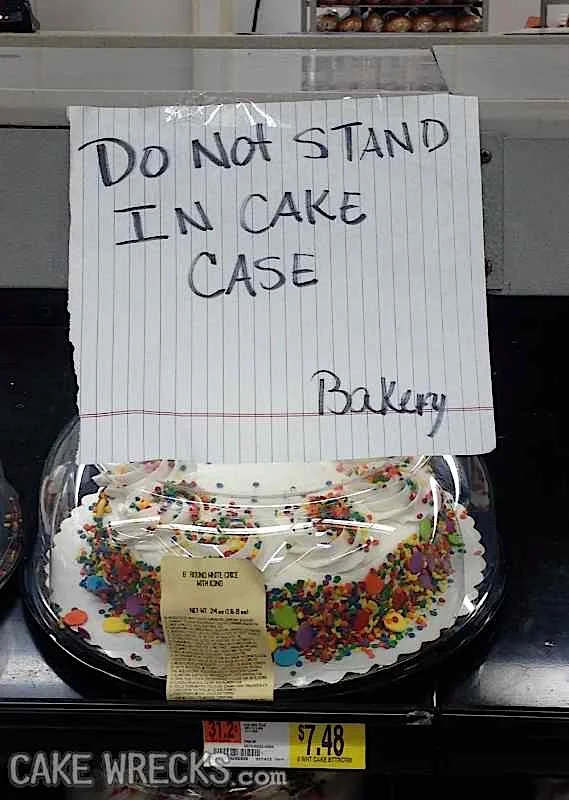
DO NOT

stand

in
         cake
             case

[whispering] Bakeryyyyy

****


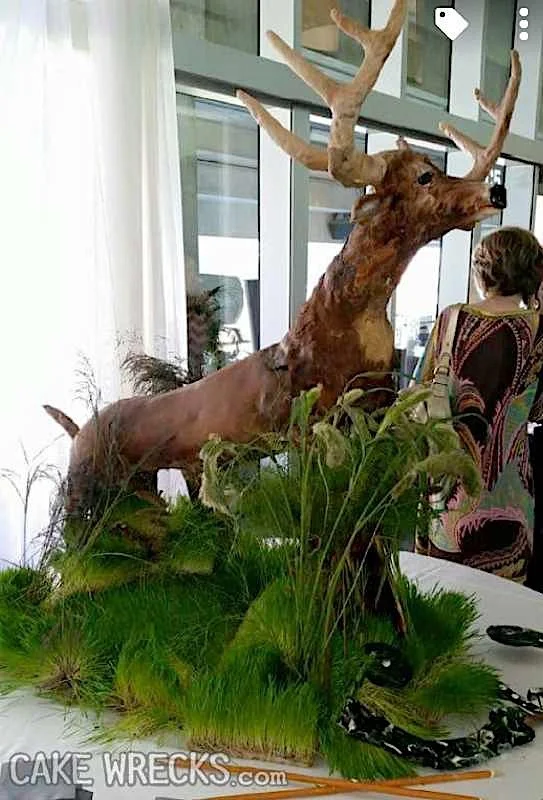
Once in a season, very near Fall
From deep in the forest, trees shady and tall

Comes something peculiar, and so seldom seen
Like a leprechaun's gold, or a unicorn's spleen

Look quickly, my brethren, for with any luck
You'll be graced with the majesty of 
Weenie Buck

*snapsnapsnap*


Thanks to Keelan M., Julia C., Jess K., Kia H., & Kristy D. for helping us channel our inner Charlie McKenzie. ("WOMAN! Whoaaaaa-MAN!")

*****

P.S. I see you appreciate poetry. Might I recommend...?

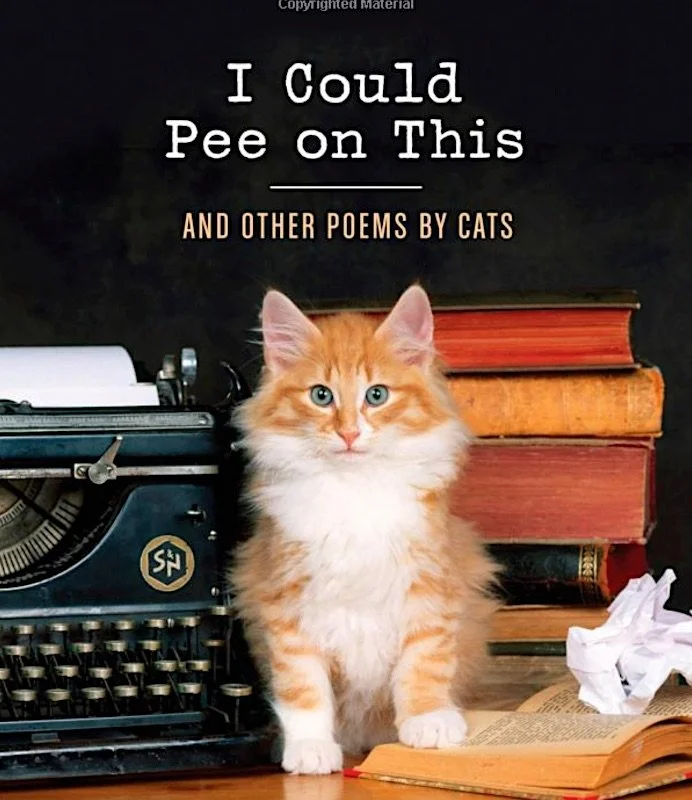
I Could Pee On This, And Other Poems By Cats
*****

And from my other blog, Epbot:

james_davis_nicoll: (Default)
james_davis_nicoll ([personal profile] james_davis_nicoll) wrote2026-05-05 08:51 am
Entry tags:

Tripoint (Company Wars, volume 6) by C J Cherryh


A mother's determination allows her son to finally meet his long-lost father.

Tripoint (Company Wars, volume 6) by C J Cherryh
The Daily Otter ([syndicated profile] daily_otter_feed) wrote2026-05-05 09:55 am

All Babies Eat Messily, I Guess

Posted by Daily Otter

This is pup Quatse in 2021! Via VAMMRS, which writes, “When the server asks how the first few bites are tasting but your mouth is too full to answer 🫠”

oursin: Brush the Wandering Hedgehog by the fire (Default)
oursin ([personal profile] oursin) wrote2026-05-05 09:34 am

(no subject)

Happy birthday, [personal profile] catvalente!
thewayne: (Default)
The Wayne ([personal profile] thewayne) wrote2026-05-05 12:53 am
Entry tags:

The new Murderbot novella(?) is out!

It released Tuesday at midnight, the title is Platform Decay. One thing that's nice about buying mostly ebooks is instant access. :-) The author, Martha Wells, recently announced that the next book may be the last in the series, especially since she only has one more under contract. She said that she's happy where SecUnit is and she doesn't want the series to go on indefinitely, plus she's happily at work on a new fantasy series, of which she has two books out right now.

She also has the Murderbot Apple TV show to work with, we shall see how long that series continues.

This book is clocking in at 170-180 pages.

https://www.polygon.com/murderbot-diaries-series-finale-martha-wells-interview/
sovay: (Sovay: David Owen)
sovay ([personal profile] sovay) wrote2026-05-05 12:03 am

Eating cereal, remembering the sky

With great disgruntlement, Hestia submitted to the invasion of her sovereign space as I cleaned and restocked the pantry, disposing in the process of many of the shredded paper bags in which she had been pleased to nest and very unfairly folding the unshredded ones into the indispensable bag of bags, out of reach of the mighty paw of kitten. I have been so ill for so long that I have been barely cooking for myself and tired of it: nothing is superabundant, but groceries were included among the errands I spent my day running. The shelves tidily contain cornmeal and jam and tinned fish and soup. [personal profile] spatch organized his ramen. When I have finished cleaning the counters, I will be able to bake something. I just heard a train whistle blowing in the night, which always makes me think of Tom Waits' "Gun Street Girl" (1985). Someday I will eat a seaweed cheese.
low_delta: (Default)
low_delta ([personal profile] low_delta) wrote in [community profile] birdfeeding2026-05-04 10:44 pm
Entry tags:

recent visitors

birds-2605-orioles-2.jpg
Orioles came by tonight at dinner time.

see more )
james_davis_nicoll: (Default)
james_davis_nicoll ([personal profile] james_davis_nicoll) wrote2026-05-04 07:05 pm

Inspired by a Space Wizard discussion on Discord

Space wizard cultists but instead of one sanctioned cult and one forbidden cult, there are hundreds of space wizard cults, each of whom is convinced they have the best space wizardry. So they're continually fighting to see whose is better.

The Space Emperor's antipathy is due to the disruption caused by incessant space wizard cultist fights.
redbird: closeup of me drinking tea, in a friend's kitchen (Default)
Redbird ([personal profile] redbird) wrote2026-05-04 06:53 pm
Entry tags:

another pointless medical test

I saw Carmen (my PCP) this afternoon, in person. I couldn't remember why we'd scheduled this in person, but assumed we had a reason at the time, but when I asked, Carmen didn't know either.

She wrote the next Ritalin prescription; listened to my heart and lungs as long as I was there; and had me provide a urine sample for a once-a-year toxicology screening. In theory, that screening is to make sure that the patient is actually taking rather than selling their Schedule II drugs. The thing is, the standard/required test panel is for about a dozen things, not including Ritalin. There is a test for that, which she didn't order because the sample would have to go to a different lab, and she trusts that I'm taking the medication as prescribed.

I'm also supposed to schedule a mammogram.

It's a nice day, so I went to Tosci's afterwards, and now have a pint each of sweet cream and lime vanilla ice cream.
james_davis_nicoll: (Default)
james_davis_nicoll ([personal profile] james_davis_nicoll) wrote2026-05-04 03:36 pm
Entry tags:

I think I passed some sort of threshhold

So now email like this shows up frequently.

Read more... )
rachelmanija: (Books: old)
rachelmanija ([personal profile] rachelmanija) wrote2026-05-04 12:06 pm

When We Were Real, by Daryl Gregory


One day everyone in the world woke up with these words in front of their eyes, somehow inscribed in their inner eye: YOU ARE LIVING IN A SIMULATION. Simultaneously, a number of impossible things appeared on Earth, apparently to prove it: a frozen tornado, windows between continents, etc.

It's now seven years later. Those words still appear before everyone's eyes periodically. And tours have sprung up to take people to see the Impossibles, or at least as many as can be seen on a seven-day bus trip.

This extremely high-concept premise resembles that of The Measure in some ways: a world-spanning event, clearly real and equally clearly done by a more-than-human power, with immense existential implications, and with no one having any idea why it happened or why it happened now. But this is Daryl Gregory and he's very good with bizarre high-concept premises, and this book is excellent.

The other genre of When We Were Real is "set of random people thrown together" story. A number of the characters are, at least on the surface, straight out of a 1930s train story or a 1970s airplane story: two nuns, a rabbi, a pregnant woman, an elderly woman in a wheelchair and her devoted daughter, a set of elderly tourists, a person who's secretly dying, a person with a secret identity, a fugitive from the law. The only stock character it's missing is the cute child.

The many characters are very human and likable, with even the most frustrating of them having reasons for being the way they are; the annoying pregnant influencer's reason for being an annoying influencer turns out to be both sympathetic and heartbreaking. (Yes, it's partly to provide for her upcoming baby, but the real question is "Why an influencer rather than some other job?")

Read more... )

The Impossibles themselves are excellent. My favorite was the time tunnel, where you can stay an infinite amount of subjective time (you get a home pulled out of your own history or desires, plus fresh-baked bread every morning) and emerge several hundred miles away, only a second having passed outside. But the flock of non-real sheep was pretty great too.

There's serious themes - existentialism, mortality, meaning, God, ethics, love - but delivered with a light touch. It's more plotty than I expected, given the quest/picaresque structure, and the story is very satisfying. You don't get answers to all the questions, but you do get a general outline as to what's going on and why. It's a very human and humane novel, of the moment but in a good way.

Content notes: Cancer. Plans for suicide due to terminal illness. Pregnancy and birthing issues. Violence.
james_davis_nicoll: (Default)
james_davis_nicoll ([personal profile] james_davis_nicoll) wrote2026-05-04 02:43 pm
Entry tags:

Bundle of Holding: Critical Kit Solos


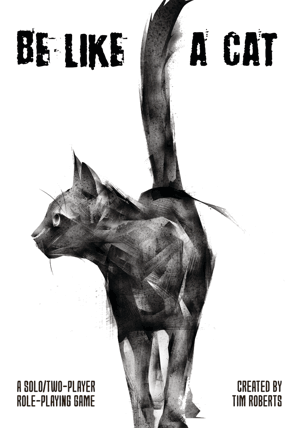
This all-new Critical Kit Solos Bundle presents Be Like a Cat, Be Like a Crow, and other one- and two-player tabletop roleplaying games from designer Tim Roberts at UK games publisher Critical Kit Ltd.

Bundle of Holding: Critical Kit Solos